First Days of May – Bob Romano
It’s hard not to smile as I tramp through a meadow sprinkled with dandelions and buttercups. Upon my approach, a pair of robins fly onto a nearby apple tree, pink blossoms sprinkling down from its branches. For the first time since last spring, I can feel the sun’s warmth on the back of my neck.
A warm breeze carries with it the scent of honeysuckle as I draw closer to the stream. The delicate petals of violets, bluets, and wild geraniums add touches of soft color along the path leading down to the water. I wake a garter snake lying across the trail, watch it slither into the high grass beside the narrow path. The melodic notes of a white-throated sparrow rise from a tangle of brambles. Although black-and-white warblers are hidden among the tops of the sun-dappled hardwoods, their calls sound like rusted wheels.
Rain, having fallen earlier in the week, has brought the little freestone brook back to life. Like an old friend, the sound of the current rises to greet to me. I pluck a pheasant-tail pattern from the tin carried in my shirt pocket, a fly with mahogany hackle wound parachute style around a calf-tail post, a generic imitation of a mayfly, one of my favorite patterns when fishing Bonnie Brook. Slipping on a pair of reading glasses, without which it would be impossible to thread the 5X tippet through the eye of the hook, I tie an improved clinch knot and secure the fly with a bit of my saliva before pulling it tight.
After entering the stream, I stumble across cobble and stone. On my first attempt, the tiny bundle of feathers falls short of its target. On the next, it becomes tangled in the thorny branches of a wild rose. I’m casting a seven-foot fly rod crafted from cane by the Pennsylvania artist and rod maker, Tom Whittle. After days of ice and snow over the long winter months and rain and sometimes sleet during an especially damp April, it takes time, but eventually my rhythm returns. Working upstream, the #14 fly bounces down riffles, over seams along the edge of the current, and beside an undercut bank.
As the pattern drifts through a set of shadows, a trout slashes through the surface, a crimson sash down its nine-inch flank. Another rises from along the exposed shoulder of a boulder. This one is no longer than six inches, a brook trout, with brightly-colored spots speckled across its sides and a belly the color of honey. I release a third fish after it slips from under the trunk of an ash tree fallen across the stream.
Not long afterward, I come to a bridge. A number of years back, after a hard rain had swelled the stream, I released two brook trout from the pool below the concrete abutment, each measuring twelve inches. Ever since, I’ve cast my flies into that run, for what is fly fishing if not an exercise in hope, although like so many occasions before this one, I leave without encountering a fish.
Wading under the bridge, I disturb a phoebe from her perennial nest of mud. Emerging back into sunlight, I cast above a plunge pool, holding high the cane shaft while watching the calf-tail bob up from the rush of current as the fly swirls over a dark stretch of water no wider than our kitchen sink. When the fish rises through the foam, I pull back, the bamboo tip trembling with life—another rainbow trout, this one nearly ten inches.
Seated upon a moss-covered boulder, I clean the fly with a chamois patch cut from the sleeve of an old shirt. Working the pattern through a bottle of desiccant, I glance down at a mass of trout lilies. An occasional yellow flower rises from their mottled leaves as they spread across the forest floor joining a colony of Mayapples. A few feet away, are patch of horsetails, those survivors from the Paleozoic era. A chipmunk chatters a complaint from the far shore. After apologizing to the little rover, I move on.
The hardwoods turn to hemlocks as the stream narrows, forming a series of plunge pools like steps tumbling under the shadows cast by the second-growth conifers. I release two more fish, brook trout—one a fingerling, the other, a tough little bruiser, with a fierce-looking jaw. In a larger run, one I call Landing Pool, because it appears at the top of the steps, I make a decent cast, watch the pheasant-tail float down a seam, until it’s taken by a scrappy fish that zigs and zags before coming to my hand.
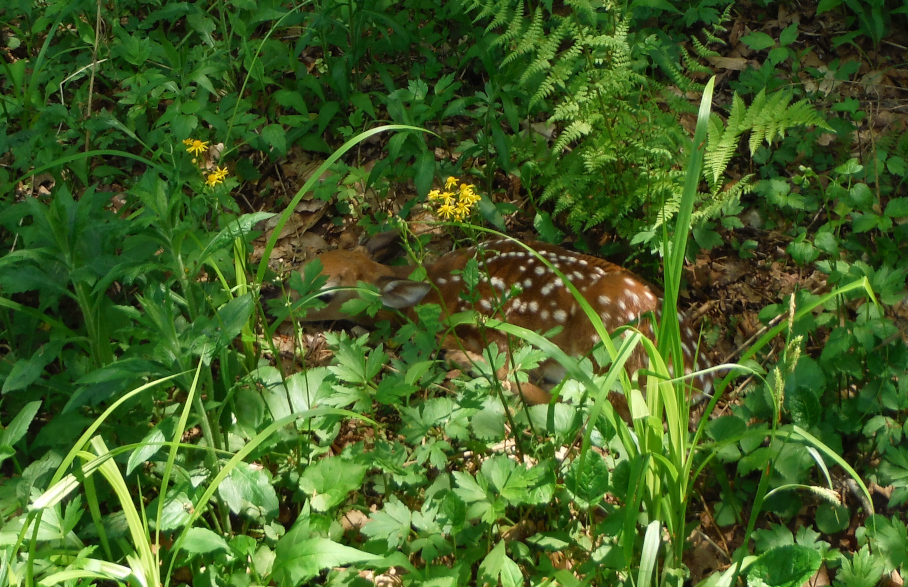
It’s a brown trout, A surprise this high up. Watching its six-inches slip from my moist palm, I decide it is a good fish on which to end the afternoon. Closing my eyes, I let the sound of the current carry me along with it, until a rustling under the hemlocks draws my attention away from the stream. Trilliums rise through the duff. A colony of lady’s slippers spreads outward from the trunk of a fallen tree. Higher up, red-and-gold flowers of a columbine, like little trumpets, rise from between a crack in a large boulder. And then I see her. Lying perfectly still, tawny sides, white dots, duplicating the earthen surroundings. It’s the eyes that give her away. I slowly step back into the stream, not wishing to disturb the newborn fawn.
On the long tramp back to the truck, a quote attributed to Confucius comes to mind. It goes something like “Life is really simple, but we insist on making it complicated.”
 Slate Run Sportsmen